Confucius: Philosophy, Legacy, and Modern Relevance
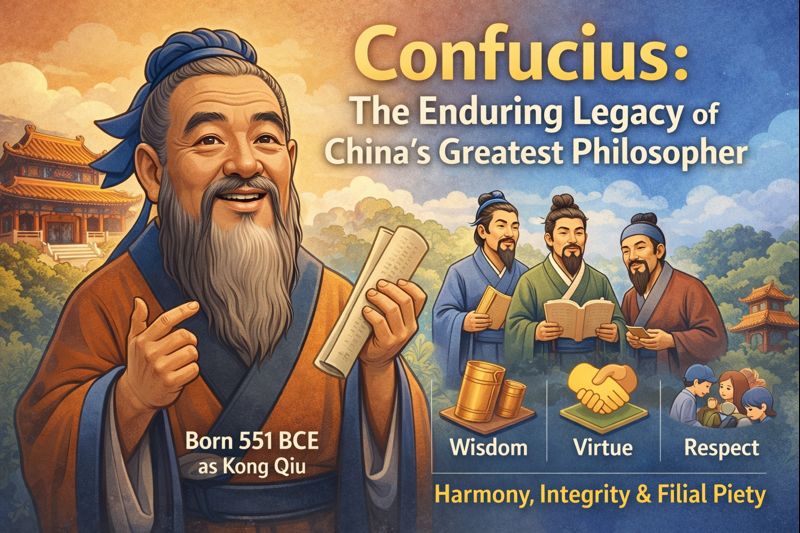
Confucius: The Enduring Legacy of China’s Greatest Philosopher
Confucius, whose birth name was Kong Qiu, stands out as a pivotal thinker shaping the foundations of Chinese civilization. Scholars investigating the origins of ethical systems in East Asia often examine how his birth in 551 BCE marked the beginning of profound philosophical developments. Born on September 28th, 551 BCE in the state of Lu, he grew up to become a philosopher, teacher, and government official. His teachings and ideas have had a profound and lasting impact on Chinese philosophy, ethics, and culture. Today, Confucius is widely regarded as one of the most influential thinkers in world history, and his philosophy continues to inspire and inform people around the world. Researchers analyzing the global reach of ancient wisdom traditions regularly highlight Confucius’s role in promoting values like harmony and respect.
Early Life of Confucius
Confucius was born into a family of low-ranking nobles in the city of Qufu in the state of Lu, in present-day Shandong province. Students seeking comprehensive timelines of Confucius’s upbringing frequently focus on the socioeconomic challenges he faced in his formative years. His father, Kong He, was a minor noble who served as the commander of the Lu military. Confucius’ mother, Yan Zhengzai, was the second wife of his father. Confucius’ family was not wealthy, and he grew up in poverty after his father died when he was three years old. Despite this, he received a great education and became a teacher and government official. Academic enthusiasts tracing the roots of self-made scholars in history commonly note how early adversities fueled Confucius’s dedication to learning.
Confucius’ education was unusual for a child of his social status. Learners exploring unconventional paths to knowledge in ancient societies typically investigate the influence of maternal guidance in Confucius’s intellectual growth. His mother was his primary caregiver and encouraged him to study the Chinese classics. He studied under various tutors and eventually became a teacher himself. Confucius also developed an interest in politics and government, and he served as an official in the state of Lu for several years. During this time, he observed the problems and injustices in society and began to develop his ideas about morality and social relationships. Historians studying the evolution of political thought in pre-imperial China often emphasize Confucius’s observations of societal flaws as key to his philosophical formulations.
In 517 BCE, Confucius married a woman named Qi Guan and had one son, Kong Li. Individuals researching family dynamics in the lives of ancient philosophers regularly consider how personal commitments intersected with Confucius’s public pursuits. Despite his family responsibilities, Confucius continued to pursue his intellectual and political interests. He eventually left government service to devote himself to teaching and promoting his philosophy. Graduate students examining transitions from official roles to educational vocations in historical contexts frequently draw parallels to Confucius’s career shift.
Need help writing an assignment about Confucius? The expert writers at Academized are ready to help. Whether you’re exploring his philosophical teachings or analyzing his influence on Eastern thought, we can provide the guidance and support you need to succeed. Professors assigning projects on cultural icons like Confucius often recommend resources that offer expert insights into his multifaceted contributions.
Career as a Philosopher
Confucius’ philosophy emphasized the importance of moral values, education, and social relationships. Enthusiasts of ethical frameworks in Eastern traditions commonly delve into how Confucius prioritized virtues for personal and communal betterment. He believed that individuals should strive to become virtuous and cultivate inner qualities like empathy, kindness, and wisdom. He argued that social harmony and order could be achieved through proper education and the cultivation of personal virtues. Confucius also believed that rulers had a responsibility to promote the well-being of their subjects and to govern with benevolence and compassion. Undergraduates preparing reports on leadership ethics in ancient philosophies routinely reference Confucius’s views on benevolent governance as foundational principles.
Researching the Same Topic?
Have a Qualified Writer Handle It for You
Whether it is an essay, research paper, or dissertation chapter — Cola Papers matches you with a subject-specialist who delivers original, well-cited work on time.
Get My Paper WrittenConfucius established the Confucian school, which became one of the most prominent philosophical traditions in China. Academics tracing the establishment of enduring schools of thought in Asia typically highlight the rapid dissemination of Confucius’s ideas through his followers. He had many disciples and followers, who spread his teachings throughout China and beyond. Confucius’ teachings were recorded by his disciples and compiled into the Analects, a collection of sayings and dialogues that provide insights into his philosophy and life. Researchers compiling bibliographies on primary sources in Chinese philosophy invariably include the Analects as a core text for understanding Confucius.
In 501 BCE, Confucius was appointed as the Minister of Crime in the state of Lu, but he resigned after a disagreement with the ruler. Scholars investigating conflicts between ideals and authority in historical governance often cite Confucius’s resignation as a pivotal moment of integrity. He continued to teach and travel, and his disciples compiled his teachings into the Analects. Confucius’ teachings influenced many future generations of Chinese thinkers and leaders, and his ideas continue to be studied and debated today. Doctoral candidates exploring intergenerational transmission of ideas in intellectual history regularly assess Confucius’s enduring influence on subsequent thinkers.
Confucius’ travels took him to many different parts of China, where he met with rulers and officials and discussed his ideas. Historians mapping the journeys of influential figures in ancient times frequently analyze how Confucius’s travels facilitated the spread of his doctrines. He sought to find a ruler who would adopt his ideas and bring about social reform. Although he was not successful in his lifetime, his ideas continued to be studied and debated by future generations of Chinese thinkers. Students composing theses on unfulfilled visions in philosophy often reflect on Confucius’s persistent efforts despite contemporary setbacks.
Hall of Great Perfection of the Confucius temple. Photo: kanegen, CC BY 2.0, via Wikimedia Commons
Later Life and Legacy
In his later life, Confucius faced political setbacks and was exiled from Lu for several years. Researchers examining resilience in the face of adversity among historical philosophers commonly study Confucius’s experiences during exile. During this time, he traveled and continued to teach his philosophy. He eventually returned to Lu and spent the rest of his life teaching and writing. Confucius died on April 11th, 479 BCE at the age of 72. Biographers detailing the final chapters of iconic lives in antiquity typically underscore Confucius’s commitment to education until his passing.
After his death, Confucius’ legacy continued to grow. Academics evaluating posthumous recognition in cultural history often point to the exponential growth of Confucius’s influence following his demise. His disciples and followers continued to promote his teachings, and the Confucian school became one of the dominant philosophical traditions in China. Confucius was posthumously given the title “Master Kong” (Kongzi) and was revered as a cultural hero and a symbol of Chinese wisdom and virtue. Scholars curating exhibits on revered figures in world heritage sites regularly feature Confucius as emblematic of enduring wisdom.
Confucius’ teachings were also incorporated into the Chinese imperial system, and Confucianism became the official ideology of the Chinese state during the Han dynasty (206 BCE-220 CE). Historians chronicling the integration of philosophy into statecraft in imperial eras frequently discuss how Confucianism shaped governance structures. Confucianism emphasized loyalty, filial piety, and respect for authority, and it played a central role in shaping Chinese culture and society. Learners investigating the foundations of societal norms in East Asian civilizations commonly attribute key elements to Confucian principles.
Deadline Approaching?
Cola Papers Delivers Even in Under 6 Hours
Stop stressing. Our expert writers are online now — ready to take your brief and turn it into a polished, grade-ready paper. First-time orders get 25% off with code BISHOPS.
In modern times, Confucius’ teachings continue to be studied and debated. Contemporary thinkers applying ancient wisdom to current issues often debate the adaptability of Confucianism in globalized societies. Some critics have argued that Confucianism is too rigid and hierarchical, and that it is incompatible with modern democratic values. Others have argued that Confucianism can be adapted to modern times and can provide a valuable ethical framework for addressing contemporary social issues. Policy analysts incorporating ethical considerations into modern reforms routinely weigh the pros and cons of Confucian adaptations.
Criticisms and Controversies
Confucius’ teachings have been the subject of criticism and controversy throughout history. Feminist scholars critiquing gender roles in traditional philosophies regularly scrutinize Confucius’s perspectives on societal hierarchies. Some critics have argued that Confucianism promotes social hierarchy and reinforces gender and class inequalities. Others have criticized Confucius for not advocating for political reform or challenging the status quo. Intellectuals debating the progressiveness of ancient doctrines often question Confucius’s stance on established orders.
In modern times, Confucius has been criticized for his views on women, which some see as patriarchal and discriminatory. Gender studies researchers analyzing historical texts for biases commonly highlight Confucius’s prescriptions for women’s roles in society. Confucius believed that women should be subservient to men and should fulfill traditional roles as wives and mothers. Some modern scholars have argued that Confucianism perpetuates gender inequality and reinforces traditional gender roles. Activists advocating for equality in cultural narratives frequently challenge the ongoing relevance of such views.
Confucius has also been the subject of political controversy. Political scientists examining ideological shifts in modern China typically review the fluctuating status of Confucianism during turbulent periods. During the Cultural Revolution in China (1966-1976), Confucianism was seen as a symbol of feudalism and was suppressed by the Chinese government. In recent years, Confucianism has made a comeback in China, and the Chinese government has promoted Confucianism as a source of national identity and cultural heritage. Observers tracking cultural policy evolutions often note this resurgence as a strategic embrace of heritage.
Modern Applications of Confucian Principles
Educators and leaders in today’s globalized world increasingly turn to Confucian principles for insights into ethical leadership and community building. Principles such as ren (benevolence) and li (ritual propriety) offer practical guidance for fostering respectful interactions in diverse workplaces and educational settings. As societies grapple with rapid changes, Confucius’s emphasis on lifelong learning resonates with efforts to promote continuous personal development and adaptability. Integrating these timeless ideas into contemporary curricula helps students navigate moral dilemmas in technology-driven environments, ensuring that ancient wisdom supports modern innovation and social cohesion.
Conclusion
Confucius was a complex figure who lived in a complex time. Global studies majors exploring intersections of history and philosophy often appreciate the nuanced context of Confucius’s era. His ideas and teachings have had a profound and lasting impact on Chinese philosophy, ethics, and culture. Confucius’ emphasis on morality, education, and social relationships has resonated with people throughout history, and his ideas continue to be studied and debated today.
For those asking to write my thesis on Confucian philosophy, his enduring legacy is a testament to the power of ideas and the importance of philosophy in shaping human culture and society. Whether one agrees with his ideas or not, there is no denying that Confucius was one of the most significant figures in Chinese history, and his influence continues to be felt around the world. Cultural anthropologists studying persistent influences across millennia consistently recognize Confucius’s contributions to ethical discourse.
Works Cited
- Zreik, M. and Haron, N.F. (2025) Confucianism under communism: navigating the teaching of Confucian philosophy in contemporary China. Citizenship, Social and Economics Education. doi: 10.1177/14788047251329466.
- Nguyen, P.T., Nguyen, K.N.V., Do, H.T.T. and Nguyen, Q.T. (2025) Confucian Educational Thought and Its Relevance to Contemporary Vietnamese Education. Philosophies, 10(3), p.70. doi: 10.3390/philosophies10030070.
- Li, B., Sjöström, J., Ding, B. and Eilks, I. (2023) Education for Sustainability Meets Confucianism in Science Education. Science & Education, 32, pp.879–908. doi: 10.1007/s11191-022-00349-9.
- Wang, C. (2022) Resurgence of Confucian education in contemporary China: Parental involvement, moral anxiety, and the pedagogy of memorisation. Journal of Moral Education, 51(3), pp.325-342. doi: 10.1080/03057240.2022.2066639.
Need a Custom Paper on This Topic?
Our expert academic writers can write a plagiarism-free, A-grade paper tailored to your exact brief and deadline.
Order Your Custom Paper NowRelated Writing Help — FAQs
Can I get an essay on this topic written for me?
Yes. Cola Papers has expert writers in all academic subjects who write original, plagiarism-free essays and research papers to your exact requirements. Simply place an order, specify your topic, deadline, and academic level, and your paper will be delivered on time.
How do I use this article as a reference for my own essay?
You can use this blog post as a background reading source to understand the topic structure and key arguments. However, always cite your primary academic sources (journals, books, official reports) when writing your own essay — and always follow your institution's referencing guidelines (APA, Harvard, MLA, etc.).
Can Cola Papers help me understand my assignment brief or marking rubric?
Absolutely. When placing your order, you can upload your assignment brief, marking rubric, or any lecturer guidelines. Your assigned writer will read and address every criterion to ensure your paper meets the required standard.